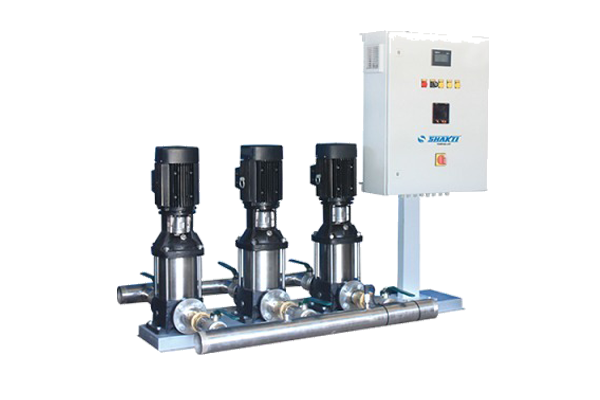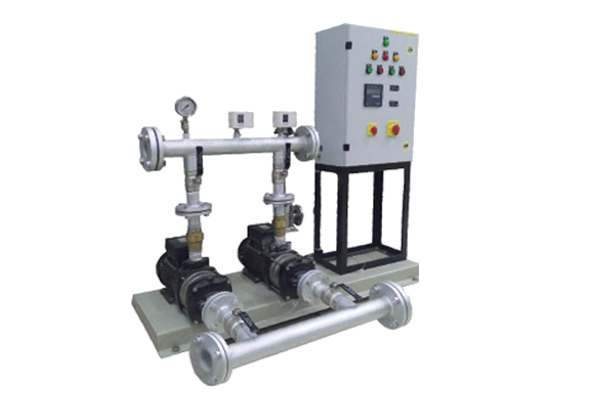
The control panel decides how a boosting system behaves — how tightly it holds pressure and how much energy it burns doing it. We build three panel types in-house, each with an optional IoT layer. Here's how they differ and where each one fits.
Fix Speed (FS)
A fixed-speed panel switches pumps fully on or off using contactors, holding pressure within a band using a pressure switch and the tank as a buffer.
- Best for: simple, budget-sensitive installations with steady demand.
- Trade-off: pressure moves within a band rather than staying flat, and pumps draw full power whenever they run.
Single VFD (SV)
A single variable frequency drive continuously varies pump speed to hold a constant set-point pressure. In multi-pump systems the VFD "floats" across pumps while the others run fixed-speed as needed.
- Best for: most residential and commercial buildings — the sweet spot of cost and performance.
- Benefit: flat pressure and real energy savings, since power falls sharply as speed drops.
Multi VFD (MV)
Every pump has its own drive, so all pumps can modulate together. This gives the smoothest control and the best efficiency across the widest demand range.
- Best for: large or critical installations with highly variable demand.
- Benefit: maximum efficiency and redundancy; any pump can lead.
The IoT layer sits on top
Any of the three can be ordered IoT-ready, adding remote monitoring, alerts and consumption history through our device-app-cloud platform. Fixed-speed systems benefit from monitoring; VFD systems benefit from both monitoring and control.
Key takeaways
- Fix Speed: simplest and cheapest, pressure moves within a band
- Single VFD: constant pressure + energy savings for most buildings
- Multi VFD: smoothest control and efficiency for large/variable loads
- All three are built in-house and can be IoT-enabled
- Panels are available B2B to other manufacturers too